Age Verification Lobbying: Dark Money, Model Legislation & Institutional Capture
How corporate lobbying, think tank infrastructure, competing model legislation, and obscured funding networks are shaping age verification policy across 45 states and Congress.
What This Investigation Found
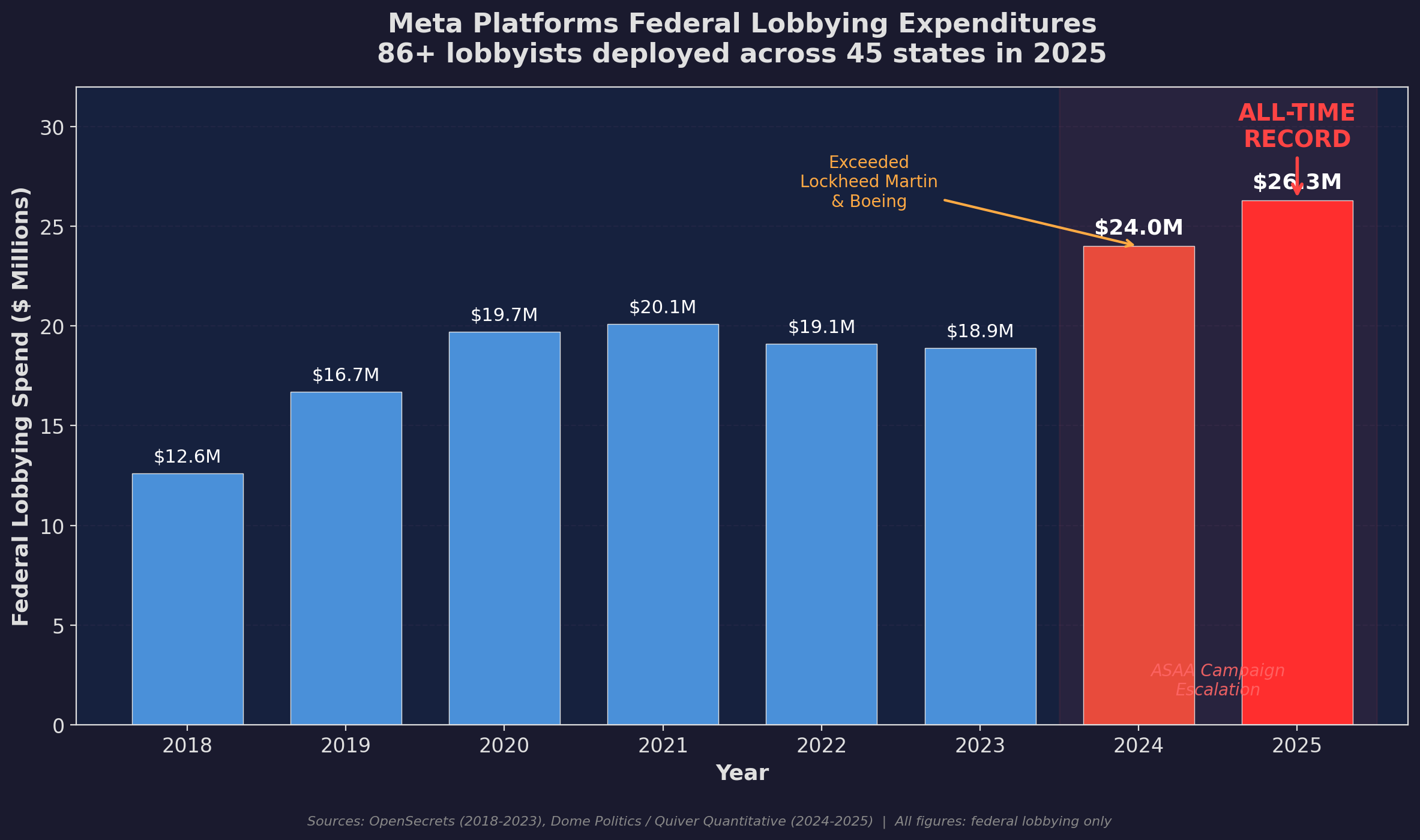
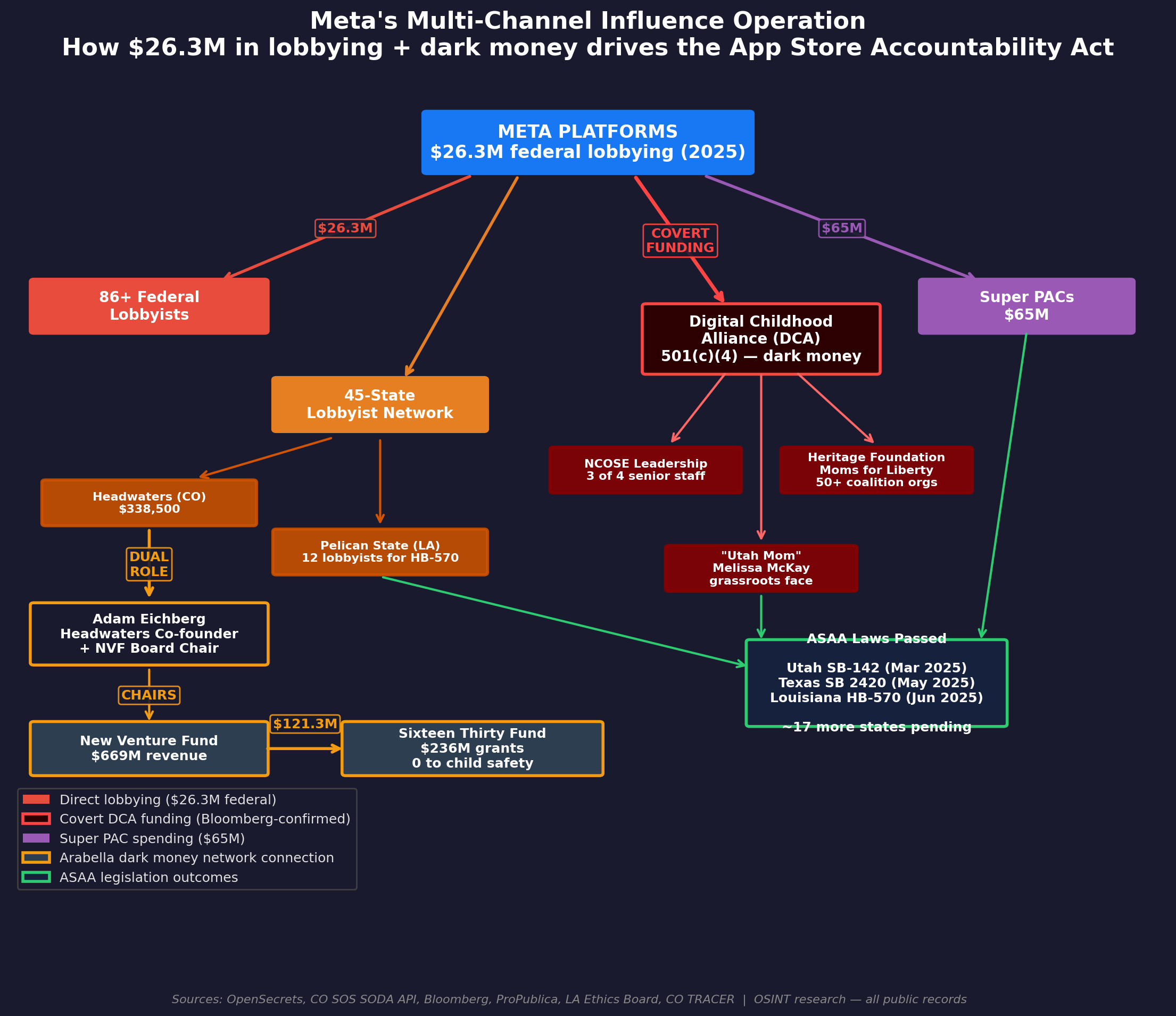
This investigation documents a national lobbying operation spanning corporate spending, think tank infrastructure, dark money networks, and competing model legislation templates. Meta spent a record $26.3 million on federal lobbying in 2025, deployed 86+ lobbyists across 45 states, and covertly funded a group called the Digital Childhood Alliance (DCA) to advocate for the App Store Accountability Act (ASAA). But the operation extends beyond Meta.
The Heritage Foundation funds three of six named DCA coalition organizations, staffs the advocacy pipeline from Capitol Hill to state legislatures, and has merged leadership with another coalition member. A competing model bill (ICMEC’s DAAA) takes a different approach, creating a two-track legislative landscape where both tracks shift regulatory burden away from social media platforms. Snap, X, and Pinterest have joined Meta in supporting ASAA. Every confirmed supporter is a social media platform; every opponent operates an app store.
This investigation traced funding flows across five confirmed channels, analyzed $2.0 billion in dark money grants, searched 59,736 DAF recipients, parsed LD-2 filings, and mapped campaign contributions across four states to document the operation.
The pattern extends internationally. Meta spends EUR 10 million annually on EU lobbying (the largest single company spend), retains 18+ consulting firms across jurisdictions, and uses at least three firms operating in both Brussels and Washington. In Brazil, Meta appeared at legislative hearings for PL 2628/2022, though Brazil\’s resulting law placed the burden on platforms directly. ICMEC, which authored the competing DAAA model legislation aligned with Meta\’s interests, operates under severe financial distress with Meta as a confirmed major donor. Over 30 jurisdictions introduced age verification bills within an 18-month window.
Every finding is sourced from public records: IRS 990 filings, Senate LD-2 lobbying disclosures, state and EU lobbying registrations, campaign finance databases, corporate registries, WHOIS/DNS records, charity filings, and investigative journalism.
Nine Documented Tracks
Each track documents a distinct pathway through which age verification legislation is advanced, funded, or staffed.
$26.3 Million, 86+ Lobbyists, 45 States
Meta retained 40+ lobbying firms and 87 federal lobbyists in 2025 (85% with prior government service). Meta's own LD-2 filings with the Senate explicitly list H.R. 3149/S. 1586, the App Store Accountability Act, as a lobbied bill.
At the state level, confirmed operations include $338,500 to Headwaters Strategies (Colorado), $324,992+ across 9 firms and 12 lobbyists in Louisiana, and $1,036,728 in direct California lobbying (Q1-Q3 2025 alone).
A Meta lobbyist brought the legislative language for Louisiana HB-570 directly to the bill's sponsor, Rep. Kim Carver, who confirmed this publicly.
Digital Childhood Alliance: A Shell Advocacy Group
DCA is a 501(c)(4) advocacy group that Meta covertly funds. Bloomberg exposed the funding relationship in July 2025. Under oath at a Louisiana Senate committee hearing, Executive Director Casey Stefanski admitted receiving tech company funding but refused to name donors.
DCA has no EIN in the IRS Business Master File, no incorporation record in any state registry searched (CO, DC, DE, VA, OpenCorporates), and no Form 990 on file.
DCA's domain was registered December 18, 2024. The website was live and fully formed the next day - a 77-day pipeline to Utah SB-142 signing. Every blog post and testimony targets Apple and Google. Meta is never mentioned or criticized.
DCA's coalition count inflated from 50+ to 140+ with only six organizations ever publicly named.
ConnectSafely, a Meta-funded child safety group, classified tech company donations as "program service revenue" for nine consecutive years (2015-2023) to avoid Schedule B donor disclosure. In California, Meta supported AB-1043 while DCA opposed it, indicating DCA operates independently enough to break ranks with its funder.
$70M+ Across Four State-Level Super PACs
Meta committed over $70 million to four state-level super PACs:
- ATEP - $45M, bipartisan, co-led by Hilltop Public Solutions
- META California - $20M
- California Leads - $5M
- Forge the Future - Texas, Republican-aligned
Forge the Future's stated policy priority is “empowering parents with oversight of children's online activities,” which mirrors ASAA language exactly.
All super PACs are registered at the state level rather than with the FEC, scattering disclosure filings across individual state ethics commissions instead of a single searchable federal database.
Meta is not alone: Snap, X, and Pinterest have confirmed support for ASAA bills. Every confirmed supporter is a social media platform; every opponent operates an app store.
The Dark Money Connection
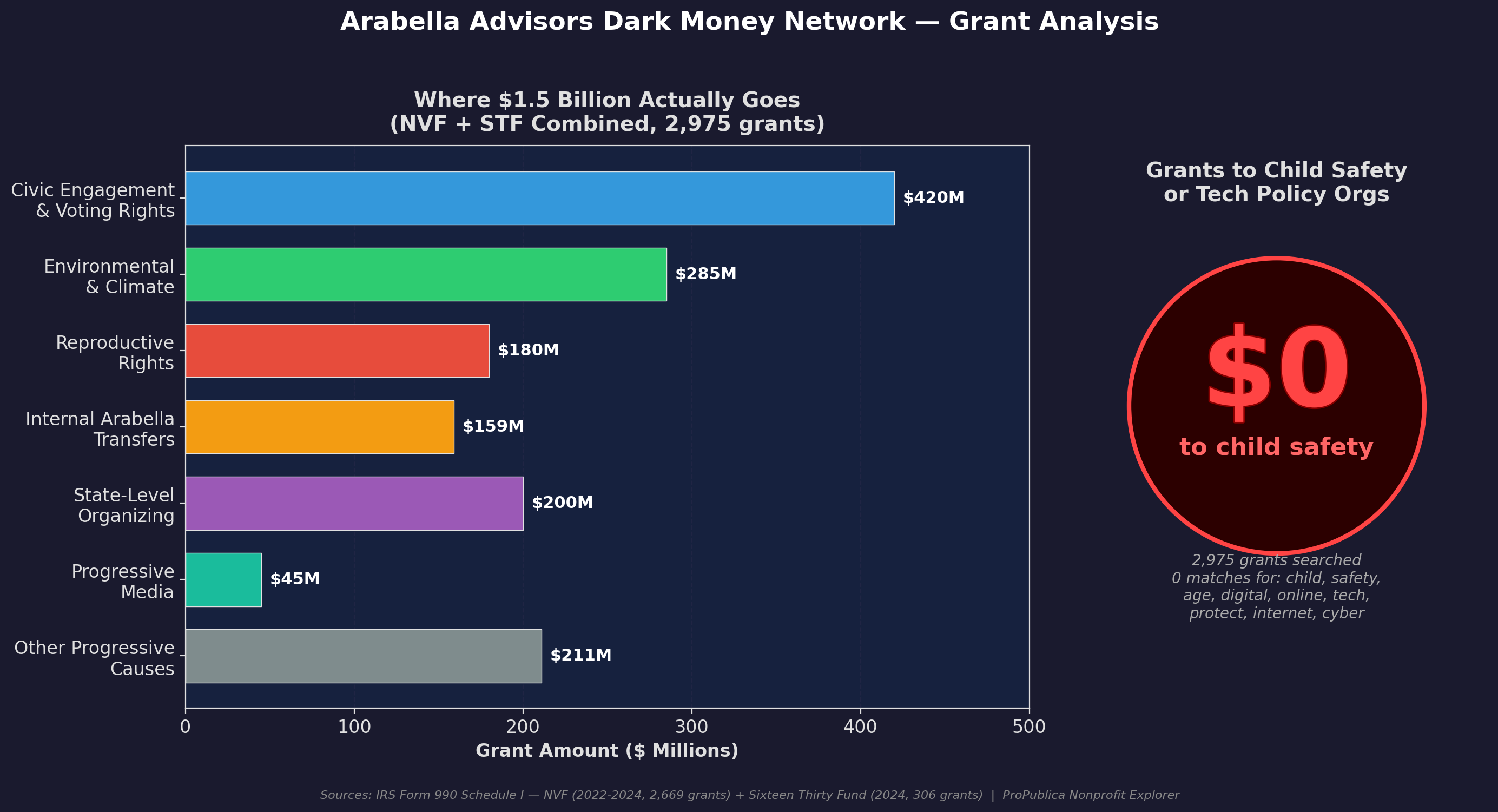
Meta's Colorado lobbyist Adam Eichberg simultaneously serves as Board Chair of the New Venture Fund (NVF), the flagship 501(c)(3) of the Arabella Advisors network. NVF transfers $121.3 million annually to the Sixteen Thirty Fund, a 501(c)(4) with no donor disclosure requirements.
All five Arabella entities' grant recipients were analyzed: 4,433 grants totaling approximately $2.0 billion. Zero dollars went to any child safety organization, definitively ruling out the Schedule I grant pathway.
The Heritage Foundation funds 3 of 6 named DCA coalition members (NCOSE, IFS, EPPC). A former Senate staffer from Sen. Mike Lee’s office moved to Heritage, then endorsed DCA on launch day. Meta hired a Heritage fellow (Dustin Carmack) in May 2024.
If Meta money flows through the Arabella network, it travels via fiscal sponsorship, consulting fees, or lobbying expenditures - more opaque than grant disclosures.
Three Laws Passed, 17+ States Pending
ASAA has been signed into law in three states:
- Utah SB-142 - Signed March 26, 2025 (first in nation)
- Texas SB 2420 - Signed May 2025 (paused by federal judge, December 2025)
- Louisiana HB-570 - Signed June 30, 2025 (effective July 1, 2026)
Forge the Future spent $1.36 million in Texas ahead of March 2026 primaries (11 wins, 1 loss). Roughly 17 additional states have introduced or are considering ASAA bills, including Kansas, South Carolina, Ohio, Georgia, and Florida. The federal version was introduced in May 2025.
Policy Infrastructure Provider
The Heritage Foundation is not a passive coalition member of the Digital Childhood Alliance. It is an active policy infrastructure provider that funds three of the six named DCA coalition organizations, staffs the advocacy pipeline, and has merged leadership with another coalition member.
Heritage funds three DCA core members:
- NCOSE (National Center on Sexual Exploitation) - DCA institutional backbone, likely fiscal sponsor
- Institute for Family Studies (IFS) - $50,000 Heritage Innovation Prize for "Protect Kids Online" research underlying ASAA
- Ethics and Public Policy Center (EPPC) - $50,000 Heritage Innovation Prize for "Protect Kids Online"
The Senate-to-Heritage-to-DCA pipeline: Annie Chestnut Tutor served as legislative assistant to Sen. Mike Lee (who introduced the federal ASAA), moved to Heritage Foundation as a Policy Analyst, and was a launch-day endorser on the DCA website one day after domain registration. Heritage funded the research that supports the bill that Meta lobbied into law.
Institutional merger: Tiffany Justice, co-founder of Moms for Liberty (another DCA member), became a Heritage Foundation Visiting Fellow and was then hired as Executive Vice President of Heritage Action. Two of DCA's six named coalition members are now functionally the same entity at the executive level.
Heritage-to-Meta pipeline: Dustin Carmack, Heritage Foundation fellow and author of Project 2025's Intelligence Community chapter, was hired by Meta in May 2024.
Two Competing Model Bills
There are two distinct model legislation frameworks at the state level, often conflated:
- ICMEC's Digital Age Assurance Act (DAAA) - device/OS-level age verification, places burden on operating system manufacturers
- DCA's App Store Accountability Act (ASAA) - app store-level age verification, places burden on app stores (Apple, Google Play)
ICMEC is a separate organization from DCA. Meta donates to ICMEC, but ICMEC's DAAA model actually competes with Meta's preferred ASAA approach. Both approaches shift regulatory burden away from social media platforms.
ASAA enacted: Utah, Texas, Louisiana, Alabama. Pending in Kansas, South Dakota, Ohio, and roughly 17 other states.
DAAA enacted: California (AB-1043, co-sponsored by ICMEC). Pending in Colorado (SB26-051).
In Ohio, the two templates compete directly: Meta backs HB-226/SB-167 (ASAA), Google backs HB-302/SB-175 (DAAA). Two tech companies funding two competing age verification approaches in the same state.
The National Association of Christian Lawmakers unanimously adopted the ASAA as model legislation at their 2025 conference at Liberty University, making it the first national organization of elected officials to do so.
30+ Jurisdictions in 18 Months
Age verification bills were introduced across 30+ jurisdictions within an 18-month window (October 2024 to March 2026), an unprecedented temporal clustering.
EU: Meta spends EUR 10 million annually on EU lobbying, the largest single company spend, retaining 18+ consulting firms and 30 declared lobbyists. At least three firms (Trilligent/APCO Worldwide, White & Case, FTI Consulting) operate for Meta in both Brussels and Washington. Meta's VP of Corporate Communications explicitly called Trilligent "integrated members of our Meta team."
Brazil: Meta's Tais Niffinegger (Manager of Public Policy for Safety and Well-being) appeared at both Senate CCDD and Chamber CCOM hearings on PL 2628/2022. The bill became Lei 15.211/2025, signed September 2025. Critically, Brazil's law placed the compliance burden on platforms directly, not app stores or devices. Meta failed to execute the ASAA playbook outside the US.
UK: Childnet International, a Meta-funded child safety group, signed a January 2026 joint statement calling for "a requirement on platforms to use highly effective age assurance," which contradicts Meta's device-level approach. The Charity Commission is currently assessing concerns about Childnet after critical comments about Snapchat (a funder) were censored from young ambassadors' speeches at Safer Internet Day 2024.
Meta's child safety lobbying is deliberately compartmentalized by jurisdiction. US federal lobbying firms have zero overlap with EU firms. State-level firms are jurisdiction-specific. No cross-jurisdictional overlap was found on age verification work specifically.
Obscured Funding Channels
ICMEC financial distress: ICMEC, which authored the competing DAAA model legislation, has negative net assets of -$2.28 million, persistent annual deficits, and cut its workforce 38% (21 to 13 employees). Board members loaned the organization $1.117 million to fund operations. Meta is a confirmed $25,000+ major donor. Despite financial fragility, ICMEC invested heavily in policy papers and model legislation promoting device-level age verification throughout 2024-2025.
ConnectSafely UK wire: ConnectSafely has wired approximately $100,000/year to an unnamed UK organization since 2022, totaling $297,500 over three years. The most likely recipient is Childnet International, based on their 17-year co-membership on Meta's Safety Advisory Board. ConnectSafely received exactly $100,000 from the Pershing Square Foundation for the same amount as the UK wire, raising questions about pass-through funding.
ConnectSafely donor concealment: ConnectSafely classified tech company donations as "program service revenue" for nine consecutive years (2015-2023) to avoid Schedule B donor disclosure. No tech company name appears in any 990 filing despite confirmed funding from Meta, Google, and Microsoft.
For Good DAF: 59,736 grant recipients across five years (approximately $1.73 billion) searched with zero matches for DCA, NCOSE, or any related entity. DCA is classified as a "Project" (ID 258136) in the For Good system, not a standalone nonprofit.
The Lobbying Network
Deep Dive
283 Documented Findings
All documented findings with source citations, filterable by category. 184 high confidence, 93 medium, 6 low.
Investigation Timeline
Key events from DCA domain registration through state law signings.
Research Documents
29 analysis files covering IRS filings, lobbying disclosures, campaign finance, and more.
Methodology
OSINT techniques, source categories, and verification approach.
Press Contact
Key findings summary for journalists, downloadable charts.
Source Repository
Full source data, 29 analysis files, and interactive HTML reports. Also mirrored on Forgejo.